Sunday, February 19, 2006

Films & Reviews

I've not had much time recently to study whether a film is worth seeing or not, just get a sense of the "babble" in the air that it's good. So, went to "Good Night, and Good Luck" last night. Beautifully cinematographed (is that a word?) in monochrome, all those swathes of real black backgrounds on the large screen, with the wrinkled face of "Ed Morrow" emitting immense credibility. George Clooney's new movie is about a particular element from the McCarthy witchhunts where CBS and their news presenters finally stood up against McCarthy-ism's own unAmerican activities (accusation without trial or evidence for instance.) Beautifully filmed and edited, well-acted, I think the Sunday Times review got it right when it calls it "the best looking lecture you'll ever attend." I was glad I saw the film, but its no masterpiece, certainly not a worthy award winner (except for cinematographer.) The intensity was palpable, but in itself that wasn't enough. As a story about one man's fight against injustice it hardly registered. I wanted to see a documentary on the subject, as a companion piece, so narrow-focussed was the piece. One character asks "what if we're backing the wrong side?" and that was the one point where light intruded. Clearly, Clooney sees this as an appropriate moment to challenge the political elite, but he does it as an insider story, with the media (and Hollywood) seen as the white knights. It doesn't detract from what was a powerful hour and a half, but like that other recently well-reviewed film, Broken Flowers, it lacked depth. I realise, despite good dialogue, that it was painfully underwritten - ALL black and white - a director's film, with a limited source material, and - probably - a need to have known more about the subject before the film. A good small movie, visually exemplary, but short on the very articulacy that we're currently lacking.

Tuesday, February 14, 2006

Bar Fiction

Is there a new type of fiction being written these days? Or a new generation that's about to pop its head over the parapet? It sometimes seems so - though you wouldn't know it from the lists of the major publishers. Where's the contemporary experience? The last Booker shortlist was heavy on historical; packed with literary pastiche. Highly acclaimed and high selling writers like Sarah Waters seem to have it all ways; yet in Morrissey's immortal words, it says nowt about my life. I guess you get the high water mark of one sort of highly conservative writing in Ian McEwan's "Saturday", a novel set in the present day (and a very particular present day), but almost by mere accident. It's a fine drawing room novel. Yet, having rarely been in a drawing room, I'm not convinced its got any relevance to me either. I wouldn't say there's a generation as such - I'm close to 40, and I'm talking about writers as well who are closer to 20; but it does strikes me that the fallout of the Thatcher years is beginning to have its artistic fallout as well. If its people around my age and a little who were politicised by music (or got into music by the politics), then perhaps as the children being born then start, in certain circumstances with a different set of priorities. I guess there's two parallel generations now anyway, those who are born to be consumers, (mobile phone, iPod, gap year, Chantelle, Chelsea), and those who are already seeing themselves locked out (second-hand vinyl, Arctic Monkeys, Oxfam, FC United) - and its not a class thing; you can be in either lot whether you've been to a finishing school or just finished at a sink school. It's more a tribal attitude. If you want to do anything (say, bring up non-obese kids, recycle bottles and paper, eat knobbly carrots, see a local band, write a poem) that has no monetary value then you're in one tribe; if the cost not the value is what you value then you're in the other. Its perhaps that which makes one uneasy at tonight's vote banning smoking in public places - its an assault not just on bad health (and bad manners) which I applaud but on a life less governed. That it comes a day after the same government has ok-d I.d. cards despite not winning any of the arguments, seems only right. I guess any of these things can be picked and mixed on one side or the other. For me its those who think for themselves and those who don't. What has this to do with fiction? Well, everything, of course. I guess if we're not writing Sarah Waters' historical romps, or Zadie Smith pastiches, then we're writing something else. There's been various "names" for scenes over the years that have been both derogatory and explanatory of any kind of fiction that has a local or domestic focus; kitchen sink dramas; aga sagas. I guess what I'm seeing is a kind of "bar fiction" that's set in a bar - not a pub, not a wine bar - for its crucial scenes, since none of the characters own their own homes, or are part of inclusive professions. Bars are an English thing, kind of modelled on some historical antecedents, in Paris, New York, wherever a few writers and creatives gathered; but grown out of the English pub. I used to wonder why I wrote so many scenes set in bars and whether it was a lack of imagination, but then I realised that the bar is the common land of the contemporary city. In bars you drink, you sit, you read the paper, or write in your Moleskine; you might eat there or listen to music, but these are minor affectations. Unlike the "Disco Biscuits" club fiction, bars are where you talk, and listen. They're called things like "The Bar" (Chorlton-cum-Hardy); or Cord Bar or Bar Centro(the Northern Quarter, Manchester); they're not just a Manchester thing, but Manchester does them pretty well - I looked in vain for one in Newcastle at the weekend - and its the pivot for a particular kind of bar fiction. Gwendoline Riley's two novels "Cold Water" and "Sick Notes" hardly leave the place; Lee Rourke virtually lives in one; I pivot in and out; Max Dunbar - a writer we recently published in Lamport Court - stumbles in and out of them. But these might be the last days; the bars might already be over - the smoke (and smokers) gone, and something of their controlled anarchy. You won't find a bar in a novel by Ian McEwan, Sarah Waters or Zadie Smith. It's a small point, but a telling one.

Monday, February 13, 2006

Literature and Bands

I'm going to get a copy of the Sexus single "The Official End of it All" (ZTT records), courtesy of eBay, the band that Manchester-based writer Paul Southern was once in. Its a strange business the crossover between fiction and music. A recent Michael Moorcock interview reminded me of his time with the acquired taste that is Hawkwind; there's Nick Cave's And the Ass Saw the Angel, and Dylan's Tarantula, part of which made it into the Penguin Book of the Beats. Don Paterson's a musician as well as poet, and Rick Moody plays in a band. An ex-Belle and Sebastian member Stuart David wrote an acclaimed novel "Nalder Said" ; and then there's Sleeper's Louise Wener. Not as uncommon as one thinks, in other words. Writers have guested on records - e.g. William Burroughs - but tend to stick to it being a hobby like Moody; Moorcock's example a rare one of synergy, though Hawkwind may be one of the few bands that history will find impossible to rehabilitate. I guess the occasional article about the "poetry" or "narrative" of a singer/songwriter hides the fact that the more likely connection is none at all. Oasis's Noel Gallagher recently bragged about never having read a book; which says a lot for the Manchester education service - both good and bad - unkind non-fans might say, you can tell from his lyrics. Yet, the far more cerebral Thom Yorke writes indescribably bad lyrics.

Friday, February 10, 2006

Primary, Secondary, Tertiary

What sort of creative are you? Are you a "primary" - writing new work. Or a "secondary" perhaps a biographer or a journalist or something similar? Or "tertiary" working in the creative industries but a bureaucrat, an arts administrator or similar. I only ask. I'm a "primary", by the way, but this blog shows I'm also a "secondary", but I've never even quite managed to get a job as a "tertiary" - bookseller, administrator or the like - not in the arts at least. A recent job interview was pretty much a "tertiary" one, and I blew it. I was totally nervous, babbling about everything rather than answering the questions. Post-mortem; I was trying to fit my "primary" and "secondary" persona into a job that I could have done very well at if I'd just stuck to the "tertiary." The problem is: weirdly enough, you only seem to get a shot at these "secondary" and "tertiary" jobs if you ARE a successful "primary." Poets as professors; novelists as reviewers. Conversely, you ony seem to get a shot at the "primary" if you're already in the "secondary" or "tertiary" - journalists with book deals, agents turned authors. Doing a non-arts related "tertiary" job and combining this with my "primary" work seems to somehow suit my temperament; but it doesn't always make it easy to move between the two. And I'm probably making a moutain out of this particular molehill, of course. Because maybe its not the primary-secondary-tertiary split that is important but the professional/amatuer. I don't make money from any of my creative activities, so therefore I'm an amatuer. And maybe I'm happiest being that way. I wouldn't be the first.

Tuesday, February 07, 2006

Censorship

Since I mentioned the Danish cartoons of Mohammed, events have moved on a lot and I've thought long and hard whether I should add to the mountains of commentary. A friend once said I was a "rebel without a cause", but being civilised, educated, thoughtful and literary, I'd amend that to say I'm "without a cause", but have hardly rebelled. However a conformist without a cause (to conform to) is just as damaging in the long-run. If I have a cause, then "freedom of speech", is one. If I have an enemy, then "institutionalised religion" is it. Yet, being anti-religious in a country where that is perfectly all right, perhaps even encouraged, it makes me wonder whether I should concentrate what "fire" I have on something that has such an unimportant role in my life. May as well be anti-Speedway or anti-Morris-Dancing; my opinions on both are pretty much irrelevant. Yet being pro-free speech its the one thing that does get me riled. Though, even here, in the free-space of the internet, having been anonymously vilified a couple of times, I'm aware that with freedom comes responsibility. In the original pieces on the Danish cartoons (They are on the internet if you've not yet seen them, www.aldaily.com will take you there if you want to see them) nothing was said of their context - that they were published because of this very debate about "depicting" Mohammed. As someone from a Christian background I was a bit "deaf" to the particular offence of depiction. As Christianity iconises Christ (albeit usually a very white, non-Jewish looking Christ), I'd forgotten that Islam prevents this depiction of the prophet. You have to wonder if a 7th century Saatchi and Saatchi had come up with this peculiarity of the brand - "hey, Mohammed, keep your mystery, it's all you've got" - "but what about Jesus, he's everywhere...", "you're a me-too brand, Mohammed, you have to differentiate, Avis to Hertz, Pepsi to Coke..." Now, here's the problem, I'm not sure, if that conversation is in itself offensive to Muslims, if so, I apologise, but wonder how else I'm supposed to talk openly - and humorously - about this topic. Bill Hicks used to do a great skit on Jesus's 2nd coming, only to find everyone wearing jewellery showing him nailed to the cross. Now Allah is God, Mohammed is his prophet, therefore there's a massive difference with Christianity where Jesus is both prophet and deity. (The Catholic Church's veneration of Mary is more appropriate a distinction between the two religions, and perhaps an inevitable contradiction of a son of God born of woman.) But what I am sure of now, after the outrages of the last week, that it is the depiction of Mohammed that has so outraged Muslims, since this is forbidden by the religion. It's bad taste of the worst kind I guess. (I'm not sure whether you could show Allah instead or just read his name on a fish?) The Guardian has been all mealy-mouthed about free speech for the last couple of weeks, and generally dismayed at the cartoons, but has since decided that civil unrest is slightly worse in the scheme of things. (Ah, to see a liberal confused... a wonderful sight). I guess what I'm saying is that I think it is imperative that non-religious people and communities can comment and comment fiercely on the dogmatic beliefs, customs and views of organised religion; not forgetting, as someone who believes "all men and women are equal" there is not a religion in the world that doesn't find some excuse for oppressing women whicheve way it can get away with (another debate, but a very valid one - like when Tony Blair went to the Pope's funeral, you could only wonder whether he'd go to the funeral of anyone other Homophobe?) but that one should respect things that are gratuitously offensive to people who follow that faith. I've got the impression from the last week or so that Muslims are okay with satire, criticism, but not - and I don't think they should be - with this gratuitous disrespect. That kind of summarises my own permission. Yet there's something weird here. The very "world" nature of Islam seems to see a brotherhood amongst peoples that is in itself disturbing. A British Muslim aligning themselves in sympathy with the religious government of Iran for instance is deeply disturbing; just as a British working man in the thirties aligning himself with Hitler would have been. It is not "Islamophobia" which seems on the increase around the world but anti-semitism. I was stood outside of Marks and Spencers in Manchester a year or so ago and I asked why people were protesting against M&S. "Because they're Zionists", was the reply that the middle-aged white man gave me, "its well known." M&S is a PLC which means it predominantly owned by pension funds; you and me in other words. It would be entirely possible for a rich Muslim company to buy M&S if it so wanted, I guess. I wondered why M&S was being protested against as opposed to Debenhams or Sainsburys, and the only conclusion I could come to was that it was a company with a well-known Jewish history. This seemed perilously close to anti-semitism, rather than just being pro-Palestine. I mention this with some concern and some loathing, since - though these are things I have no right to have a real opinion on - the demonisation of the Jews was one of the key elements of Fascism, and it should be possible for us to now live in a world where it is possible to criticise America without being pro-Zionist, and it is possible to criticise the regimes of the Middle East, without being anti-Islam. It is with some misgiving that I hear that the abhorrent, opinionated, insane Abu Hamza has been jailed for seven years from today. This is astonishing to me: that in a country that believes in free speech anyone, however abhorrent their views (and it is for his views that he has been charged and jailed), could be imprisoned. (But on second thoughts, I'm not really that concerned that such a nasty piece of work is finally getting his comeuppance. Maybe I should be, but perhaps he created a climate of fear and loathing, and that's enough.) Unwrap all of this and I'm not sure there's a present here any more, just a series of wrappers, each smaller, more crumpled and more dispiriting than before. (But read this for a more erudite discussion of the issues.) An interesting article in yesterday's Times on a Manchester-based writer, Paul Southern who lives in Longsight as an "alien", unable to be seen with his Muslim girlfriend because of the approbation from her friends and family. I've not heard of Southern before, nor the almost-made-it band Sexus he was once in, yet the article seems to imply he's got no choice about where he finds himself, whilst being aware of the absurdity of it. The photograph that accompanies the piece sees him stood on the curry mile, rather than in the depths of Longsight, probably the most cosmopolitan road in Manchester.

He sits in the French House every Sunday so that we don't have to

Lee Rourke's Scarecrow was one of the reason's I restarted my blog-life, and the story he's just posted up there is the best thing I've yet read by him. Being Lee Rourke is Boring could appear in a British McSweeney's if such a thing existed, although maybe Scarecrow is that thing. This observational piece about Soho's French House is timed like the best of jokes, and that's what makes it so much more than just observation. Lee goes to the French House every Sunday so that we don't have to, distilling the rather tranquil boredom of the alcoholic's choice of boozer into an exquisite little story. The latest Scarecrow missive adds H.P. Tinker to the list of alumni and its quickly becoming one of the web's finest fiction showcases. Recommended. But, hey, Lee, mate, you need some more bookshelves...

Wednesday, February 01, 2006

Political Writer

Because I write fiction, drama, poetry, non-fiction and music - its perhaps hard to see that my essential themes are entirely consistent. Whether I choose a particular style, or form, or subject, I would say there's always a deep seriousness to my intent if nothing else. Articulating this to a literary friend, I realised I kept coming back to the fact that I am a political writer; highly aware of the contemporary world, and how any art needs to at least acknowledge it, even if its not the explicit subject. The irony, of course, is that without being traditionally published, one's political voice is pretty muted. I was watching newsnight last night, following the government's defeat on its Religious Hatred bill amendments. Perhaps this is too technical an issue for it to have any "legs" as a news story, but already its buried away from the newspaper front pages. Today the paper's were full of the 100th British soldier to die in Iraq, and the nightly news even managed to unearth a photograph of Tony Blair's meeting with Corporal Gordon Pritchard on December 22nd in Basra. It has been a frantic political month, with an apparently radicalised government acting - depending on your views - either like a first-term government should, with radical change; or with the desperation of the late Major years (nothing to match the privatisation of the Railways yet, but we've still identity cards to come.) A political writer, I guess, might be expected to be outspoken about "issues", like Pinter, or Rowan Atkinson's criticism of the religious hatred bill. On a day that this has been going on, a Danish cartoon has outraged Muslims for depicting Mohammad, yet a fish in Rossendale is being praised for having Allah's name on it in Arabic. As a commentator you can comment on this, have an opinion on this, or a stance on this. As a political writer...? I would want to connect the Allah fish with the Danish cartoon with the Geopolitics of contemporary Iraq, with George Galloway on Big Brother, and with the launch of a the most powerful British warship today on the Clyde. But I would also want to do something else; perhaps find an allegory that could make sense of this, or an everyday experience that might be affected by this. I am a political writer, yes, but read my work, not my opinions, to understand what that might mean.

Tuesday, January 31, 2006

The horror! The horror!

To the Library Theatre tonight to see the ever-reliable Lip Service's new show "Horror for Wimps." This was a spoof on horror movies rather than their usual literary fair, and rather than the songs that have peppered previous shows, it was an impressive use of specially recorded video clips that impressed. It was incredibly enjoyable to see technology used in this way; with the slippage between the two "worlds" of the present day, and fifties horror film, almost like David Cronenberg's Existenz in its slickness; albeit sillier. (Or not quite as silly, depending on your view of Cronenberg.) It was fun, as well, to see how our new super-size TVs "dominate a room" just like the old fifties ones did - this time, its the picture and surroundsound rather than the casing - but it was a timely reminder of how things come around. Of course, one of last years big films was "King Kong."

Friday, January 27, 2006

Secret Agents

Talking with a friend about spies. More particularly, she was reading Graham Greene's "Our Man in Havana" and we were musing on the English spy novel. Came to the conclusion that in the modern sense it probably began with Conrad's "The Secret Agent", but came of its own more during the 20th century. I mentioned the Dreyfus letter as a good real-life example of a "spy" like story - but thinking back they've been around for as long as their was literature. Dante, Shakespeare, Marlowe, Chaucer, all might have had "spy" on their c.v. Conrad aside, it took a while for the spy novel to have any sort of literary status - more the Dennis Wheatley's of the world than more erudite writers. It's a boys own literature of course, and Greene must have had something to do with it getting its literary chops. Film, of course, as well. The "Cold War" was spying's golden age of course, and from Fleming to Le Carre, spy novels have often been made into spy films.

Saturday, January 21, 2006

Into the Valleys

I was interested to read in the Guardian about the establishment of the Library of Wales, an initiative to bring back into print Welsh "classics." The first, Ron Berry's "So Long Hector Bebb" sounds worth a read, a boxer from south Wales making his comeback. It makes me wonder whether we have a fiction of "place" anymore, and what it's validity might be. These, after all, are Welsh writers writing in English. But if there is such a thing as an Australian fiction or Canadian fiction I'm well able to believe there might be a Welsh one. With a not over-ambitious, but not insubstantial aim to bring 10 books a year back into print over 5 years, its a rare undertaking of blinding common sense. Secondhand books websites and secondhand bookshops have furnished most of my purchases over the last few years; so books not being "in print" is not always a problem - and I can only assume that the Library of Wales, like other small publishers, will have a long-term view of its own backlist, otherwise, in 10 years time these editions will be the one's lost and forgotten. There's recently been more talk of "electronic paper" making the eBook a real possibility at last. I guess, for non-fiction, its possible, but for narrative fiction? I'd be surprised to see something in my lifetime. I'm like those few people holding on to their black and white television sets, not intending giving up on books yet. In Stephen Poliakoff's recent BBC play "Friends and Crocodiles", every time some new dot-com startup mentions electronic books, the main character goes back to the old sorts, and, in a moment of absurdist humour recommends that the venture capitalists invest their money in bookshops, because there aren't enough of them.

Sunday, January 15, 2006

Little Gidding
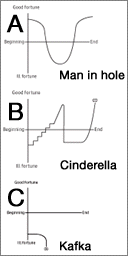

Tomorrow will see the announcement of this years T.S. Eliot prize, essentially poetry's Booker. In a very well-reasoned piece in the Observer, ex-Poetry Review editor Robert Potts rues a missed opportunity. Through quotation, as well as comment, he deconstructs the contemporary poetry trope of choice: "An emotional event is described through a particular object, anecdote or memory, which supplies some metaphorical glitter," even the well-reviewed Carol Ann Duffy collection - a likely winner (and she did!) - is pulled apart on this. I don't think I can better that as a condemnation of the sterility of much contemporary poetry. You may think that's fine, but repeated time and again, across a range of otherwise different poets, the effect palls quickly. But he also neatly puts in the "cronyism" of the tiny poetry scene as being in itself problematic. The books can't stand on their own; not where the judges are friends - lovers even - of the writers etc. etc. Twas ever thus, I guess, and its only a shame that Potts doesn't come up with any names, apart from Geoffrey Hill, who could replace the current lists. Even sterile poetry probably deserves its award ceremony - everything gets an award ceremony these days! - its only a shame that one bearing the illustrious Eliot's name, and generously funded by his widow, isn't itself more illustrious. In yesterday's Guardian the ever-wonderful Kurt Vonnegut provides some useful graphs of the plots of various novels. His Kafka alone is priceless.

Saturday, January 14, 2006

Technique

Perhaps new years resolutions aren't meant to come at the start of the year, but gradually, as the year dawns - or perhaps these are more like new years revelations. Possibly a quiet start to the year has cleared my head a little, but I keep getting minor flashes of clarity, seeing things as they are - as I walk down the street, or as someone says something to me - and I think, yes, I should write this down. Yes, I should write this down. This has to be one of the drivers, hasn't it? Something to say! At last! (And the opposite of that "having an opinion" that everyone seems to have at the moment on such peripheral topics as George Galloway on Big Brother, or Ruth Kelly and the sex offenders register.) But I'm not sure how to say the things. You know how it is - you suddenly notice an absolute truth. Say, that people not only aren't having children any more, but they're studiously ignoring biological clocks, and just accepting that's how its going to be. Or: that the streets do seem a little safer than they used to; that crime and civil disobedience, though stil there, aren't quite as prevalent as they once were. Or: that our cities are becoming just a little bit more European, but only a little. Or more minor things than that - there's more blonde haired girls in Manchester than London, for instance. Or that literally EVERYONE has an iPod nowadays. If I had a newspaper column (or a blog?) then I could just bang them out. But I want to take these ingredients and put them into a fictional/poetic mix. I want to write something that could only be written at this point in time - a time both more comfortable than I can remember, and yet more fearful. I can't quite put my finger on what it is I'm trying to say, but feel that if I could write it down in fiction then I'd be able to say, yes, that was it. What's stopping me? Well, technique, I guess. All the models that I think of using - thriller, short story, essay, reportage - seem unfit to the task. I need, somehow to find a better writing frame on which to stretch these ideas. I need the places and characters which will inhabit the story. I need the appropriate technique for dealing for this material and making it make sense. What I notice, as well, is that the only models for this that I'm finding are not written ones, but filmic or musical. That's where the lessons need to be learnt from. Let us begin.

Wednesday, January 11, 2006

Sales Pitch

This is nothing to do with literature, I'm afraid. But was fascinated (sad!) to read the sales figures for the top 200 albums of the year. Frighteningly, 2.4 million copies of the James Blunt album were sold in the UK in 2005. Imagine that, 2.4 million people going in and asking for/handing over James Blunt. I didn't know there were that many "Smug marrieds" in the country (and what of those who'd already bought the single?) How many households are there? Around 25 million? That's 1 in 10! Its not about literature, I know but I've made the point several times that good writing needs to understand the zeitgeist. Clearly, a book set in 2005 could well be soundtracked by "Your Beautiful" however ghastly it might be. (Richard Curtis can write that one!) More intriguing is that the best reviewed Rolling Stones album for 20 years has only sold 109, 000 copies. That's how many completist fans they've got left - at most - probably a fraction of those who will see them live this year... and as for hype, don't believe it. Inverse proportion of tabloid inches to record sales must go to Pete Doherty whose Babyshambles debut album managed just 91,000 sales - less than his previous album with the Libertines still ratcheted up in '05. It just goes to show that you have to be consistent to your brand - the tabloid readers of the Pete 'n' Kate show were never going to be sticking "Down in Albion" in behind "Back to Bedlam"; and those who bought Kaiser Chiefs, Hard Fi and Franz Ferdinand in droves clearly aren't influenced by the papers. The industry - same as the publishing industry - is all about sating current appetites, so compilations aside, the only "old" albums to make it into the top 200 were by classics by Oasis, Pink Floyd and Nirvana. We may, it seems finally be over the sixties...

Sunday, January 08, 2006

Detox Literature

I'm wondering if January detox should be extended to literature. A few years ago when the New Puritans anthology came out, it seemed that this was more starvation diet than detox, most of the NPs were not getting rid of any excess (it would have required a different set of writers to take the pledge) but simply writing impoverished fiction. Since then, books have both extended and contracted (the increasingly large, gaudy books-about-nothing that have dominated this Christmas) whereas fiction, British fiction, has not done much other than it has always done. I kind of think the pumped up supersize American diet has suddenly lost its allure. If a few years ago it seemed impossible to imagine a British "Infinite Jest", it now seems impossible to imagine anyone wanting one particularly; and a review of the new Rick Moody in today's Observer reminded me that I'd never actually managed to read him. This year will see Douglas Coupland revisiting Microserfs in jPod, and I'm reminded again that "work" is one of the many subjects (alongside sport, money, sex, fame, success, the present, politics) that are mostly absent from British novels. If we clone US TV shows, swapping Donald Trump for Alan Sugar, and (in this years Celebrity Big Brother), try to mix a non-celebrity alongside the other barely-celebrity contestants, our fiction mostly remains parochial, comfort food. In some ways, we're cutting our cloth accordingly; its a big world, but our own part in it is small. Yet, I was talking to a friend at the weekend who reminisced about the history of his Italian family here in Manchester. We have these stories, but we keep them to ourselves or share amongst friends. Or else, in the rarified worlds of McEwan or Hollinghurst, create a protective shell that's only as real as the Sunday Times rich list. I'm struggling to get into Ali Smith's "The Accidental", 12-year-old narrators seem pure creative writing course - there's a terrible paragraph in the first chapter where she struggles to describe the video for A-Ha's "Take on Me" as if seen anew, through a contemporary 12-year old's eyes - its horribly laboured, and clearly will only make any sort of sense to people of a particular age - I'm sure there will be far more to the novel, and I'll stick with it, but 12-year-olds have clearly gone down the educational ladder a bit since Huck Finn. The Observer is also serialising a new Ronan Bennett novel, which he's writing as it appears - a contemporary serialisation. I'm looking forward to starting reading it, but its a shame it begins set in 1914 - how much more interesting if it was in the contemporary day? (PS it was a good start, actually and felt contemporary even if its clearly not!)

Thursday, January 05, 2006

The Booker Prize Experiment #1

Courtesy of the The Book People I got 2005's Booker Prize list in Hardback for Christmas. Yeah, I know we should kind of hate these mass-market sellers, but I'm not exactly sure where my sympathies are with these days - certainly not with the publishers. At least with hardbacks (6 for £30 since you ask!) they've got nice paper and decent binding. My recently read paperback of "The Line of Beauty" will do well to last the year. For the first time ever then, I'm going to try and read the Booker shortlist in full. It will no doubt come in useful if I ever get asked to be a judge! First off the block was Sebastian Barry's "A Long, Long Way" about an Irish soldier in the Great War. As the most easily "disappointed" of readers, its sometimes possible to think I've lost the joy of reading - but a book like this, a small masterpiece in many ways, reminds me that its only the books that are at fault, not me as reader. It easily sounded the most interesting of the shortlist, and despite my aversion to overly poetic prose, I picked it up, and haven't put it down since. Although in the 3rd person - which allows an overarching sense of perspective, critical in a book on such a subject - the voice is overwhelming throughout. Barry writes like a dream, but moreso, with a joy for the sound of his prose. There's hardly a pretension in the whole novel, yet its as lyrical as a ballad, and as earthy as a dive bar. Any book about the war is a hard one to swallow. This puts the awful "Birdsong" into the shade; and adds the humanity that was missing from "Atonement". Willie Dunne is a masterful creation; a lucky Irish runt, who joins the army because his 5'6" stature isn't enough to follow his da into the police. He's the most innocent of men abroad; yet we follow him gladly into battle. It's sometimes been said that a war sorts out the mettle of men - and lucky or not, its Dunne's humanity that shines through. Against this, the ever-complex psychopolitics of Ireland is subtle in its weave. A couple of years ago I read two novels (Magnus Mills' "Three to see the king" and Nicola Barker's "Five Miles from Outer Hope") which were, to my mind, gems that will last a generation, yet hardly troubled the selectors; and this is of the same quiet quality. Its Booker shortlisting is the least it deserved, and I'd undoubtedly not have read it without that imprimature, and if any others on the list are anywhere near as good, then it will have been a vintage year indeed. There's an admiring quote from Coetzee on the cover, and since his "Disgrace" was the last great Booker novel, it seems only appropriate. Recommended unreservedly.

Tuesday, January 03, 2006

Mitchell and Butler's Indian Pale Ale Awards Announced

This year's M&B Indian Pale Ale awards (or something like that) have been announced with Ali Smith the novel choice and Christopher Logue the poetry one, for his latest Homer. I'd say place yer money on Logue this year, no doubt about it. Oh, and I did I mention they're looking for a sponsor? (Postscript: the always accurate Metro paper seemed to think she was a novice writer plucked out of obscurity to beat the Salman's of the world with her first novel. First novel? Obviously not the same Ali Smith who was shortlisted for the Booker and the Orange for her previous novel, Hotel World.)

Sunday, January 01, 2006

The Continued Unsurprising Incompetence of Saskia and Tabitha in the Ongoing Attempt to Recognise a Good Writer When They See One

The Sunday Times, clearly anticipating a slow news year, has splashed on its front page that having sent two prize-winning novels, anonymously, to various publishers and agents, that nobody was interested. It's a good game of course, since the Saskias and Tabithas peppering the lower shelves of the British publishing industry aren't exactly the monoliths of aesthetic credibility that our literature needs or deserves, however, despite the near certainty that publishing these days is only interested in "near certainties" (Katie Price aka Jordan has a book deal, for instance), I do have some sympathy in this case. Whether anyone at all still reads Stanley Middleton is a moot point, and whether anyone under 50 actually reads V.S. Naipaul out of choice, is another one. Every second-hand bookshop is rammed with writers we just don't read any more - like Isabel Colegate and Richard Condon, and you can pick up any Margaret Drabble or Iris Murdoch you care to mention for a quid. Naipaul still gives good copy of course, and as a Nobel laureate, and a politically prickly creature his readership is likely to survive a while yet; but I have to say Middleton was a name from that distant past - yes, the Booker before it was televised. I'm pleased to say at 86 his one comment on this "people don’t seem to know what a good novel is nowadays" made me warm to him; and next time I'm in the second-hand shop I may pick up "Holiday" and give it a go. After all, unlike the other 50 manuscripts a day that the agents are complaining about, (and a good deal of the books that make it to the shelves for that matter), this one at least once had a readership.

Saturday, December 31, 2005

Soundtrack to 2005

I don't just sit here writing or reading. There's usually something playing in the background, and, if its more likely to be an old than a new record these days, it doesn't preclude me still liking the odd hit record. I have to say that I've hardly heard any of NME's singles of the year, this time round, though their favourite, The Futureheads' cover of Kate Bush's "Hounds of Love" never appealed; but then again, its about a decade since I got my kicks mainly from indie rock. It's a close run thing but LCD Soundsystem's "Daft Punk is Playing at My House" just edged out Amerie's "1 Thing" in my affections, with honourable mentions for Go! Team's "Bottle Rocket" and Gwen Stefani's "Hollaback Girl." The Go! Team album was my favourite new record of the year, just because it sounded so fresh compared with everything else. I know that liking indie music is supposed to go hand-in-hand with liking alt.lit these days, but I feel I've done my time. Besides, as far back as 1987, my favourite record of the year was Art of Noise sampling, mellow hip hop classic "Hey Love" by King Sun D. Moet. Its hard to believe that "sampling" is around 20 years old. Writers seem very conservative when it comes to their choice of music; if you always know that even young footballers get their kicks from Celine Dion and Bryan Adams, its either the Clash, Springsteen and maybe, at a push, Massive Attack for the wordsmiths. Poets of course only go for Dylan and Jackson Browne and I guess the older generation are all classical and jazz in the hope of that call from "Desert Island Discs," and young American writers just like quirky college rock like Modest Mouse and They Might Be Giants. Is it relevant? Well, it can be. Without going into a scientific survey, I'm reminded that Larkin's love of jazz only went so far, and that he had no interest in the revolutions of Miles Davis and John Coltrane. Paul Muldoon wrote a series of poems about his favourite albums - hostages to fortune, and making him seem like a much older man than his poetry might, "Parallel Lines" by Blondie was the only one I liked, if I remember correctly - and Nick Hornby's book about his favourite songs was a maddening mix of the obscure and the cerebral. I've just read Alan Hollinghurst's "the Line of Beauty" and the protaganist, Nick Guest, despite being a gay men in his early 20s during the early 80s is as classicist in his taste for music as he is in his taste in furniture and literature. There's one mention of him going to Heaven, the iconoclastic 80s gay club, but nothing of the music. Perhaps it doesn't matter, but it was a welcome relief when in Iain Banks "Complicity" the music on the stereo is the Pixies. I'd be unlikely to ever write a character who was a Mahler obsessive - not because I'd find it too hard to research, I'd perhaps appreciate the challenge - but that I'd find it impossible to imagine a contemporary character under 40 for whom this was a believable character trait. Not being a gay man taking drugs at Heaven in 1986 I'm not entirely sure what the playlist would be, but I guess it might include Sylvester's "You Make Me Feel (Mighty Real)", Princess's "Say I'm Your Number One", Dead or Alive's "You Spin Me Round (Like A Record)" and Farley "Jackmaster" Funk's "Love Can't Around."

Tuesday, December 27, 2005

Cold Turkey

I wonder whether we are wedded to the Christmas ceremony more as sign of futility than anything else. I love how codified it becomes, even though those codes change. The Queen's Speech, turkey dinner, Boxing Day football, the overladen tree. In my case, and indeed in the case of many of my late 30s friends, the template remains unchanged; and the family Christmas endures even if the family doesn't. Today it snowed, briefly, as if spirit willing, but body weak. After five days of email and internet purdah you'd expect to find a full inbox, but everyone's similarly full of turkey; and in the internet wastelands of family homes, I guess. I still get presents, though Amazon.co.uk has made that a more painless transaction for us all. A couple of years ago I wrote a "Christmas Day" poem, and I like it more with the passing of time. I once wrote a little article wondering why Britain produced Larkins, and America produced Lowells. I think there's a little of both influences here, however distant.

CHRISTMAS DAY

The weather was unusually mild this year.
Mid-afternoon we strode amongst swans and coots
And Canadian geese on the grass shore of the reservoir.
In the distance our house is a dot, unique detail of a still life.
We paint only with our feet, scribing our names in dust,
Then scrubbing over them, unaccountably embarassed.
The roof of the conservation centre is moss covered,
And the lead swan, beak like a drill, badmouths at me -
I turn around - even in the natural light
Grey spots mist my eyes over, turning my head.
The unasked-for walk had somehow punctured
What usually happens - we'd sit here
Rolled-up in the floral chairs, watching the Queen's speech,
Making points off each other, having had our fill.
Each year, the same cards draped over the mantle,
From a man my dad knew in the army and the wife he'd never met
Or that old couple who were neighbours of the uncle in
Wales.
I stayed out of it; leaving my best words for those I truly might love -
Tentative girls who've texted at
midnight "Hppy Xms xxx."
I know what comes next from other years,
Boiling in too close proximity, we steam over
Spilling our worst over the hob, emptying another glass.
So how come we're sat here still liking each other?
Not looking either forward or back,
Even grateful for the familiar shows, and the Christmas tape
My dad always plays. My sister, fully expectant
With their first grandchild; her husband watching the football,
And me, unused to behaving with such forbearance.
The weather was unusually mild this year.

Tuesday, December 20, 2005

Annual Report Rhubarb Rhubarb Rhubarb

With Christmas nearly upon us, and the valiant British shopper returning in droves to buy Daleks, iPod Nanos and XBOXs, as well as near-record mortgage lending - pity the poor Unwins workers thrown on the pre-Xmas dole - its time to reflect on the year that was. Over Xmas period I may not be able to logon for other family members checking their emails on what may possibly be the last dial-up in Christendom by then. It's been a strangely frantic year, without signifying that much. If 2004's disasters were self-inflicted ones; 2005 the world seems a harsher place; not just the death of an old friend; or the London terror; or the horrors felt in Indonesia and Pakistan; but in the pure frenetic pace of it all. I sometimes feel the whole world is becoming a gigantic pyramid scheme, where there soon won't be anywhere to go. Wherefore art in all of this? I don't think the 21st century has yet shown its head or its hand; but I do feel there are twinklings. Surely there's a stepchange in the internet's power to influence and gain readers? The vibrancy of the Britblogs in particular, has made old media increasingly redundant. I don't think the Guardian has yet come up with an exciting new rash of writers to match its new funky size; and its also the year when listening to Radio 6 or podcasts or watching BBC3 or 4 has become the real deal, not just something at the margins. Traditional media is not sure how to respond, and so I've hardly bought a new CD or book all year - secondhand is the real treasure trove. Of the "old school" writers, "Saturday" by McEwan was neither as good or as bad as reviewers said; and "Yellow Dog" which I got round to reading was as fun a read as Richard and Judy choice "Shadow of the Wind" but probably not as well written. David Mitchell is now our best writer, it seems, fulfilling his potential with "Cloud Atlas." Outside of the "hits" I've found it harder and harder to find hidden gems. I enjoyed Tim Kendall's first poetry collection from Carcanet, "Strange Land", particularly his poetry scene epic "Ship of Fools", but found myself tired or unimpressed by the offline magazines. Did I see a good film? Or buy a great album? Its the year life took over in some ways; and as a consumer I only pecked at the service of what's out there. Even my best art experience of the year, the Summer of Love exhibition at Liverpool Tate, was retro, second-hand if you like. For my own creativity, its not been so bad; art simmers slowly, it seems, yet there's a meal at the end of it. I boiled down my poetry into a smart little set of 24 pieces; one-pagers all; sombre in tone. I also have written the best part of "novella" - which is already the longest thing I've written for 4 years. In the midst of flat moves; working hard; being a best man; the loss of a friend; and a noticeably higher cost of living; I've come out of it remarkably sane; with some writing I'm proud of and a sense that if I can can still get goosebumps at a song as daft as "My Humps" by Black Eyed Peas, then I must be doing something right.

Sunday, December 11, 2005

Art of the essay and other news

There is a new book of essays by David Foster Wallace, entitled "Consider the Lobster" - which if its a patch on his previous book of essays, A Supposedly Fun Thing..., will be essential. In other news, a graduate of the MA in novel writing at University of Manchester, Jonathan Trigell, has just won the John Llewellyn Rhys prize for his debut novel "Boy A." I picked this up remaindered in the Soho bookshop about a year ago, so it was kind of strange to read that it had got selected. To my shame, I've not yet read it, but will do. The story of a Bulger-like killer let back into society, the Boy A of the title, is one of those conceits that needs to be well-written to work. I met Trigell when one of my alumni, Mark Powell, came to speak to that year's M.A. and he talked about the book-in-progress then. That must have been...2000? It was the same night that I heard that another Manchester-taught novelist, Gwendoline Riley, had got her agent. It seems a long time ago. Back to my earlier comment about sports writing, another friend has recently turned semi-pro Cagefighter, and won his first bout on Sunday night. It surely deserves at least a story.... And its good to see Scarecrow magazine back after a little absence, no doubt digesting the new Houellebecq, though I will probably lose what remaining counterculture credentials I have by questioning the validity of "Stewart Home's" writing. For those who don't know Stewart Home is an "art project" - or then again, may not be. I recall reviewing "Suspect Device" for PROP magazine several years ago, and coming to the conclusion that it didn't really matter one way or another. I am intriqued by the project; but find the writing....well, not interesting enough. I'm reminded of how the anarchist band Crass, worried at the phallocentricity of their work to date, came up with the female-sung "Penis Envy" album; and produced a "lovely" single which was given away free with "Loving" magazine. That, is true subversion. I can heartily recommend "Love Songs", a book of Crass lyrics and history. A very un-Christmassy Christmas present last year. People who bought the new Stewart Home book "Tainted Love" also bought Nick Laird's "To a Fault", Iain Sinclair's "Edge of the Orison", Simon Reynolds' "Rip it Up and Start Again" and best-of-all room-sized Italian cookbook classic "The Silver Spoon," according to Amazon. The bookshelves of Hoxton will be groaning.

Saturday, December 10, 2005

Auditory Experiences

There is now a website where you can listen to an archive of contemporary poetry, its only unfortunate that its chosen the proprietary RealAudio solution; and I'm indebted to Ready, Steady Book for its pointing me in the direction of UbuWeb, a treasure trove of the avant garde, including, I'm amazed to hear, various recordings of Gertrude Stein amongst others. I'm becoming hopeful that what the internet has done, has provided access to some of the less accessible writers and writings of the last century. I mean "accessible" in the sense of being able to even read them; not whether or not their art is accessible (that should be self-evident, I would think). Just reading a little about William Burroughs, from the Word Virus anthology, and its clear that this concept of an "international avant garde" was a very real one. In literary terms, I guess I see it, not as "postmodern" (whatever that is?) but as a second wave of modernism. They're nearly all dead, now, of course, but everywhere you look in late 20th century culture you find Burroughs, Ginsberg, Kerouac, Bowles, Nin, Miller etc. There was Ginsberg on the Dylan documentary; talking about how he was in a room with Dylan and the Beatles, and how unprepared they seemed to be "spokesmen of a generation." It was 25 years ago this week that John Lennon was shot. I remember being woken by my parents to be told the devastating news. (At 13 I was a massive Beatles fan.) I went to school and nobody else - not the teachers or students - had the slightest interest. I've decided I should update my Beatles collection by getting a couple of the albums, rather than relying on a hotch-potch of cassettes and compilations; but listened to "Abbey Road" and faced with the double whammy of "Octopus's Garden" and (probably the worst song they ever recorded) "Maxwell's Silver Hammer" I might just stick to "Revolver."

Monday, December 05, 2005

Influencing the Mainstream

I have just read, and thoroughly enjoyed, a "Richard and Judy Book Club" choice, Shadow of the Wind by Carlos Ruiz Zafon. A book about books; and that's what attracted it to me. It was a pleasure to read it; wild and exotic cast of characters; a "story within a story" structure; an evocation of its setting, Barcelona; and a taut plot - albeit of the shaggy dog variety. There are "reading notes" at the back of my copy (!) but it doesn't mention as further reading the book it owes most to, Italo Calvino's If On a Winter's Night a Traveller; and before that - Borges - and it struck me that its the 2nd mainstream bestseller I've read this year which has Calvino and Borges as models, the other being David Mitchell's excellent "Cloud Atlas." You read a book like the Calvino and immediately wonder why so many other novels offer so little; have so little ambition - and I'd like to think that both Mitchell and Ruiz Zafon feel the same way, and have written exciting, entertaining novels with that firmly in mind. That both books are "bestsellers" and have attracted a mainstream audience (and have pleased such a hard-to-please reader as myself) seems to imply a growing up of audiences; the reading public isn't always in their early 20s; and well written novels, with a mix of the traditional (story - characters - plot!) and the inventive, are actually what we all want. If you've read writers like Calvino and Borges then these novels don't seem to be pale copies; but grateful homages - not the works of masters, but works of those who appreciate what the masters can bring. The Shadow of the Wind is translated into English by Lucia Graves, daughter of the poet Robert Graves; and I was pleased to see, as I left it at the side of my bed last night that it sat cheek and jowl with "The White Goddess" - somewhat appropriate for a novel so in love with books.

Thursday, December 01, 2005

Memorabilia


The book trade loves "memorabilia" - books about books and writers that are there as mere mementoes. Weirdly, though I hate these kind of books when they're touted as Xmas presents, (Little Books of Calms, Schott's and Shite's Miscelannies, Daisy Goodwin's poetry collections et al) I'm remarkably fond when they're the ephemera around my own literary interests. I've picture books of Fitzgerald, a "Kafka's Prague" bought in that city and now, Bruce Chatwin's Photographs and Notebooks. I don't know how this one ever passed me by? Its a real coffee table job; and whether the photos are good, bad or indifferent, somehow, since so much of his writing was around travel, it adds rather than subtracts. Hardly a bargain, at a tenner, but that's about the cheapest you'd find it on the net, and this was Oxfam Didsbury, where, clearly all my Christmasses are coming at once, I picked up Anthony Burgess's "A Shorter Finnegans Wake." If there was ever a book I didn't need, then its this one, but its a lovely sixties Faber paperback, and I'm ridiculously pleased at the find. I've bought half a dozen books this week, and all second-hand. I'm not sure I'll ever buy a new book again; so uninteresting are the high street selections; whereas go into any secondhand bookshop and you find these random gems.

Wednesday, November 30, 2005

A Waste of Shame

I finally caught William Boyd's tele-play for the BBC Shakespeare season, A Waste of Shame, dramatising what may have been behind the sonnets. I caught it at 3rd time of asking, BBC4 being kind enough to repeat its gems, but if you haven't seen it, try to, since it was, given the limitations of the budget, and the "educational" purpose of the piece (its a joint Open University production) a revelation. My own shame: I hadn't a copy of the sonnets. Realised long ago that those "complete works of Shakespeare" are unreadable, no more than furniture, and so pick up various volumes as and when required. Luckily my local 2nd hand bookshop provided a good quality Arden edition of the Sonnets, and reading the introduction I can see that Boyd's setting of the scene owes a lot to recent scholarship: the Earl of Pembroke as favoured recipient; the importance of the historical context (death of Elizabeth, the plague year closing the theatres etc.) And, whatever the reason behind its writing, its a phenomenally sustained piece of work. With Shakespeare as a poet in drama's clothing, its easy to think of the Sonnets as a postscript. If the introduction to my Arden edition sees them slow to catch on, I'd probably agree, but wonder whether Donne's lyric poems would have been possible without such an outrageous precursor? Yes, there's perhaps no direct lifts in Donne, but the "permission" that Shakespeare gives seems obviously related. If the renowned Bard could express desire, then surely anyone could? In some ways the homoerotic nature of many of the sonnets seems both important, and irrelevant. We know the Jacobite court was not the most macho of places; the theatre of the day had all the female roles played by men or young boys; marriage and heterosexual sex led to childbirth - or syphilis. It seems that young beauty is what is being celebrated - youth and sexual attraction being clear er, bedfellows, in an age where life expectancy was short, the plague was a constant threat, and medicine was rudimentary. There's a great scene in the drama where Shakespeare takes "the mercury cure"for his syphilis. Although speculation on Shakespeare's life is pretty futile, it seems that Boyd's reading has a ring of truth about it, for which he should be applauded.

Sunday, November 27, 2005

Football and literature

I have been interested in the extent of remembrance for George Best. George was 59, his peak was when he was 20-22, and he "retired" initially aged 26. Nobody under 45 should by rights be able to remember his playing, yet a bit like seeing the Sex Pistols or the Velvet Underground, everyone seems to have a memory. It's also strange, because in the sixties at least, its hard to imagine the usual middle-class commentators now writing for the newspapers, being regulars on the terraces. My own George Best memories are fleeting, and simply involve being in the same pubs as him on occasion, here in Manchester. I've a vague recollection that he'd be at various gig venues - places like the Roadhouse, Dry Bar and Night and Day - since, in the late 80s, early 90s they were about the only places that you could get a late drink. Sad as it is, and I'm aware that his funeral in Northern Ireland will be more like a state funeral than anything smaller, it seems that key to this remembrance is the insistence from the baby boomers that their memories are our memories; and that their heroes are inevitably our heroes. You see it in the preposterous UK Music Hall of Fame; the endless lists that place the mediocre "Sgt. Pepper" as the greatest album ever; and, perhaps in the continued primacy of a generation of (mostly male) writers now in their fifties. Ironically, George Best's long endgame - one that will probably see him buried with hardly a penny to his name - is perhaps the more genuine; his undoubted skills and charisma being rekindled in the memory as his last few "soap opera" years have unfolded. Neither George Best the man, or George Best the footballer was long enough on this world. Elsewhere we wallow in nostalgia. There aren't new literary or musical heroes that are allowed the same primacy in our culture. Yet, unlike the Americans, who rail against the dying light, and come up with, say, "American Pastoral", "Underworld", or "Time Out of Mind", using the experience of the life and the century, we have the Eurythmics Greatest Hits or Harold Pinter's poetry. Whereas Americans use sport in their literature, we seem reticent to do so. George Best's death has reminded us, that football is not just about the sport itself, but about the myriad lives it affects along the way - and that it's also about memory, Best coming to the club that was resurrecting itself from the Munich air-crash, that took the lives of so many of the Manchester United tea, as if fate had decreed some little recompense for that terrible loss. If I'm not mistaken, its a story entirely absent from the literature of our great baby boomer writers.

Saturday, November 19, 2005

Biography

Having just read and thoroughly enjoyed Andrew Biswell's "the Real Life of Anthony Burgess" I hesitate to make any kind of review - since in some ways, unlike with a work of fiction, it would just be filching from the book itself. It's enough to say that in this compact book, Biswell's created a comprehensive introduction to both the man and his work for new and existing readers. Though Burgess is no longer with us, many of the people he knew and worked with still are, so sensibly, I think, Biswell concentrates on the early life, and the prolific novel writing of the early sixties. Yet, he also provides a real service in annotating where the life and work intertwine, through his comprehensive knowledge of the work, both published and unpublished. I'd not thought of Burgess as a particularly autobiographical writer - there was always something too ambitious about his style and themes - yet he clearly was; and in a way that, though commonplace now, was probably unnerving in the more censorious climate of the time. He appears to be at some distance from a literary establishment; but having read Martin Amis's "Experience" about his father; and Andrew Motion's biography of Larkin, the post-war years weren't a great time to be a British writer. It's one weakness, I think, whether deliberate, or simply because it's not there, is that there's very little on his relationship with editors, agents, commissioners; which might give a different insight in the sometimes insane breadth of his work. Only in the discussions on "A Clockwork Orange" did Burgess appear to seek and find editorial collaboration. I'm reminded in some ways of Bellow, as detailed in James Atlas's biography. The Chicago man was another writer who started publishing relatively late, relied heavily on the various support that he got from marriage, and wrote almost quixotically, and not too financially successfully, until a big, unexpected hit. Biswell's biography sends one back, time and again, to the books, surprisingly few of which are still in print. It also, I think, has something to add to the the "art" of literary biography. It's not a day-by-day account, giving equal value to everything in Burgess's life, but instead, concentrates on what the author considers vital, both in terms of life events and books. In a world where most writers of non-fiction prefer to give their version of the truth, is scrupulous, not just in sources but in the various "truths" that are on both the public and private record about Burgess's life. In it's evocation of that unlucky generation, born in the first world war, and sent to fight in the second world war it is also a powerful portrait of a world that is not quite history.

Sunday, November 13, 2005

Cultural Issues (a round up)

To The Tubes at Manchester University on Saturday night. These American theatrical art-punk-rockers were a friend's choice; but it was worth seeing, for their warmth to the audience, the professional verve of much of their Rundgren-ish pop; and the semi-naked backing singer. This was a little disconcerting, actually. Every second song seemed to require a different fantasy-figure to appear on stage, whether nurse, dominatrix or pole dancer. It seemed a little, shall we say, "seventies"? One song required the lead singer to dress as one of Kubrik's droogs, though what connection there was with A Clockwork Orange was hard to see. But in the way of things, the previous day saw Andrew Biswell read from his Burgess biography at Manchester city library. I look forward to reading it, but it has to be worth buying just for the account of Burgess's typical writers day, from kicking the dog, (he had a dog!) to smoking 80 cigarettes, to drinking enough alcohol to kill a lesser man. I have a sneaking suspicion the contemporary writer generally has to decline another pint, since he's got some interview on "Front Row" he's got to stay sober for. A shame. The death of John Fowles has seen the Guardian publish some of his journals for the first time. Despite printing several pages of the actual diaries, it seems a shame that it then has to sensationalise, out of context, in its news pages. Robert McCrum, as always, makes a better last word of it, teasing out the key quality of Fowles' work in making the experimental accessible. In a world of apparently schizophrenic cultures (in this week's Guardian we have praise for Mark Haddon's poetry cheek-and-jowl with a damning for Auden and Pound, for instance, make of that what you will), it is this which marks out Fowles' work as unusual. He wasn't a high-brow playing only to the gallery, or a low-brow playing to the groundlings. He pitched his performance straight at the whole theatre, take it for what it is. In this, at least, he reminds me of Burgess, both seeing value (and not just fiscal, though that was part of it), in working with Hollywood - its worth bringing Pinter into this triumvirate, since it was his adaption of "French Lieutenant's Woman" which is the one undoubtedly successful Hollywood adaption of Fowles. Good writers, and true ones, retain their value.

Wednesday, November 09, 2005

Longhand


I've started writing poems longhand again. It's not that I ever gave up as such - poems can catch you unawares, and whatever piece of paper is to hand will do (I read today that Lennon's "Imagine" lyrics were on the back of an envelope; a much maligned medium!) but had begun writing them direct to screen, wondering if the properties of the computer word processor would have its effect on the work (the screen being landscape, not portrait for instance.) This tattered thing to the left is where I'm writing them now - unlined pages, which I think helps, and big enough pages to give me room to "spread out". Whenever I've bought a "special" book to write poems in it never works; but here they're stacking up, faster than I can type them up. I don't think I "do" tidy, not creatively at least. This seems about right.

Monday, November 07, 2005

Death of the Magus

It has just been announced that the writer John Fowles died on Saturday. He had been ill for some time. He seemed to me to be unique amongst British writers - neither part of a conformist mainstream, or of an avant garde. His books were amongst the most inventive of the 2nd half of the twentieth century. "The Collector" is a masterpiece of unsettling viewpoints, and unreliable narration - a precursor to Brett Easton Ellis and Michel Houllebecq in its fascination with a psychopath. "The French Lieutenant's Woman" is not only his most famous book, but perhaps his most influential - it prefigured the current vogue for historical fiction, but its essentially a modern novel, self aware, and cloaking its historical melodrama with metafictional devices. Even those books that were problematic, (and none of his novels is what you could call straightforward), were worth reading. If "the Magus" seems a little too much of a hippy puzzle, and "Daniel Martin" suffers from a bitter misogyny, it is more because of the difficult subjects that were set. The sense that he was a writer of a previous generation comes from the slight output of his later years; but I've always had a massive admiration for both the conviction and the quality of his work, and with the sense that he wasn't handed his success on a plate, but carved it, painful paragraph by paragraph. He will be deeply missed. (A post script, the BBC, not exactly renowned for either (a) being quick off the mark or (b) the least bit interested in any writers has been at annoyed at bloggers' lack of marking Fowles' passing. So, now I know, nobody does read this stuff I write! For more obituaries go here, and for sound of underfinanced, and overworked cultura l commentators exploding with justified anger at the establishment, go here.) . PPS Everyone's now happy, as far as I can gather - and I've discovered a few shrewd commentators into the bargain here 'n' also here) I've also got Anthony Burgess's 99 Novels somewhere around here, but like Jenny Davidson I can't find it. Andrew Biswell is reading from his new biography of Burgess tomorrow in Manchester coincidentally, so maybe I'll find it by then. I have a horrible feeling its co-habiting with Fowles' "Wormholes" which has also gone AWOL. Oh, for alphabetised shelves.

Tuesday, November 01, 2005

Definition of a decade

Has anyone seen the noughties yet? I only ask. Apparently the Social Issues Research Centre has discovered its the least er...cultural decade on record, with no defining music or fashion. I'm not really surprised - agreeing with Caitlin Moran that some things take time; and that its only when nineties man throws away his Blur and Oasis records will there really be any kind of paradigm shift. I also think the millennium had something to do with it. If decades take a while to kick start, then surely with centuries its even the more so. I think the 18th was still going strong in 1805 at the battle of Trafalgar; and probably only came into its own with the Peterloo Riots (stirring stuff); whilst the 20th century was sluggish in the extreme, requiring a great war to be got out of the way before Modernism and Communism could make their joint calls on the century. So we've got some way to go. And probably a good job since "noughties" isn't really a name I can conjure much with. I do think Caitlin has something here about the old generation throwing things out. Not just that a Booker Prize longlist that included not only Banville, but McEwan, Rushdie, Coetzee, Barnes et al; but a culture where those late sixties barnstormers will not let go. I'm not talking about Blair here - but despite being a not-exactly-young 38 myself, I'm getting tired of all these old farts holding centre stage in the culture, whether its the endless Beatles/Dylan retrospectives; the weekly Julian Barnes pieces in the Guardian; or the Star Wars-Narnia-Lord of the Rings obsession that still grips our cinema. Let go, won't you? But no, what happens now is that a few Young Turks get brought into the tent at the bequest of their elders. So there's no kicking over the statues; no telling the old folks that they just aint cool anymore.

Sunday, October 30, 2005

Class

An interesting article by Helen Rumbelow in yesterday's Times which mischievously asks the question of whether David Cameron has overcome the barrier of being "upper class" in order to get to be a potential Tory leader. For her James Bond is the last bona fide literary character who is unashamedly posh. Our heroes, according to this reading, can be many things, but not posh. There's an element of truth in all of this, and its a great little article, with her concentration on the thriller market being somewhat appropriate - since thrillers and detective stories develop in line with the times. Cath Staincliffe's single mum detective Sal Kilkenny is the more likely current model. The gentleman detective, the retired admiral turned sleuth, these are of a different time. Bond was apparently too posh for Clive Owen to play; and maybe the signing of Daniel Craig to the role is a sense of toning this down (perhaps they should have gone all the way and got David Thewliss in?). Class of course gets hazy when in a newspaper op-ed. I'm reminded of the sketch with John Cleese and Ronnie Corbett in - "I'm upper class and I look down on him because he's middle class" etc. The aristocracy are so few (have always been so few), that our fascination is as with a rare beast. I don't recall Bond's origins - was he really so upper class? Of course, the English institutions of the upper classes, Eton, Oxbridge et al, if not quite open to all, are quite amenable to arrivistes these days. There's always a Wickham around to fool a few people into thinking him a Darcy. In many ways, the upper middle classes are what we have got for a realistic aristocracy these days - they've the money for the start, and the cronyist culture of modern boardroom and political life kind of helps. It seems that David Cameron has had an easy life of it; being a "communications executive" or whatever it was he was before being an MP, sounds like the kind of nice sinecure secured for younger sons of Baronets. In literature these changes are still there. Ian McEwan, for instance, is increasingly only happy around posh characters; in his recent novels, there's the professional classes - surgeons, politicians, successful writers and film producers perhaps - at the top of the heap; then a rag taggle of the middle class (who he seems to despise in the way that Forster despised Leonard Bast in Howard's End) - you know, senior lecturers at minor universities, that type; and then the underclass (mentally ill; thugs and thieves.) Whole areas of British contemporary life are absent. An intriguing programme about Dennis Wheatley on BBC4 last night, showed him as both arriviste and snob. I watched a little of "The Devil Rides Out" afterwardsl; and its a world of opulent houses, Barons and Duchesses - a little bit Henry James, a little bit Alasteir Crowley. Class remains such a defining thing in British society, and such a signifier in its arts and literature (and don't even get me on the subject of "opportunity") that every article that states it no longer matters, only shows how much it still does. That it changes with time; that it has no fixed coordinates is as its always been - just look at how many of our Royal "traditions" are either made up to suit the circumstance, or recent inventions. It remains - I'm afraid - the English writers' subject.

Saturday, October 29, 2005

Cover Star #1
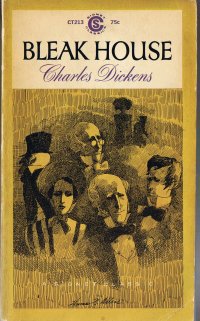

(Signet Classics Edition, 1964, secondhand £1.00)

Currently I'm reading "Bleak House" by Charles Dickens and aiming to keep ahead of the BBC series. This lovely edition is in great condition apart from a little yellowing of the spine, it looks unread, with good quality paper, and this lovely line drawing on the cover is surely better than the bland Penguin Classics?

Friday, October 21, 2005

The Range of My Reading

David Lodge famously invented a party game in "Small World" where professors of literature admitted to the books they hadn't read. Its a parlous game really. Failure to read "Hamlet" was the crime too far there. Recent posts here and elsewhere about post-war British fiction remind me of how Gertrude Stein had worried that she was reading so fast through the books she came across that she would eventually run out. It explains the length of "Making of Americans" anyway! More importantly, I guess, is that tomorrow is always more overrun with books than yesterday. One's range of reading, moreover, increases. There was clearly a border to my reading when I was eleven, and if Enid Blyton was inside it, then Jules Verne and Agatha Christie may have been just over it. No matter, you get to 16 or so, and you can dispense with borders entirely. Yet the range of one's reading is never so great as then - with so much unread, that you have to devour. There's still the unread of course, I'm shamefully only just getting round to "Bleak House" (the BBC are serialising it next week and damned if I'm going to get hooked on the TV adaption), and wonder if the Divine Comedy or Faust will ever be opened. As a writer, range is important for a number of reasons. You'll learn more about suspense from Stephen King, or pacing from John Grisham than any Don DeLillo or Virginia Woolf, and more about other things (naturally) from those two. If scientists still believe in God because as they find out more about the universe they discover the range of their ignorance, then a reader-writer gets to a point, I think, of no return. I've read "Hard Times" thank you, so "Bleak House" will hold few surprises; I've read "Birthday Letters" so who needs the collective Hughes? Sometimes it seems that I've created my own "fast forward" button for fiction and poetry, reading about it, or skimming anthologies of it. The devil as always is in the detail; however much I know from the outside about a book or a poem, it is the wonder of both, that they are not really paraphrasable. And that lack, thankfully, still can give pleasure. If I sometimes lack patience with the book I'm reading, its because I am reminded of all the ones I'm not. There's plenty to read, to watch, to listen to. I've been edging towards buying some Elliot Smith for a while, and picked up 3 of his albums recently, all excellent and all very different. I was listening to one just and thought I'd see what other albums he'd got, and it turns out today was the anniversary of his death. Having been to a friend's funeral last Monday, there's added poignancy I guess.

Tuesday, October 18, 2005

Art is David Cameron

At a friend's earlier, discussing the below post on "innovation", I tried to articulate some of the issues I'd brought to bear, and realised she was very sceptical. "Art is basically conservative," she said. I'd not really thought of this; and probably had a degree of disagreement with it. But I knew what she was saying. In literature, it is not revolutionary, but reactionary - comfortable rather than chaotic; always after the fact of scientific or social upheaval, not a precursor to it; and recycling a literate past - therefore "looking back", nostalgic, conservative in that sense. "What a good artist can do," she added, "is extend the form."

Monday, October 17, 2005

Innovation

A fascinating feature in the Sunday Times by Bryan Appleyard, asking whether we're on the brink of a new dark age, and suggesting that the pace of innovation has slowed - so that after 2 centuries of progress, we shouldn't now take this for granted. In some ways, this seems absurd - haven't we seen such an astonishing revolution in computing over the last 2 decades for instance? What about innovations in treatment for cancer, HIV etc? But we're also in a world that seems not to have changed that much - except by degree. To take a simple, perhaps banal example, the Video recorder certainly "changed lives" - or at least leisure time - by allowing to timeshift recordings, watch films more than once. Yet DVDs and hard disk recorders are merely improving what we have already got. The innovation - storable moving images - is distant. In some cases, you could argue that digitisation is not even an improvement - e.g. compare teletext with digital interactive text, the older technology is faster, with a bigger page size. We are, I guess, used to exagerrating the importance of the presence in many ways, or failing to see it in historical context, and our westernised conception of things probably doesn't help. I think its an interesting debate, though "inventions" seem only part of it; what about innovation in the arts and ideas? With historical hindsight we can see that Darwin, Freud and Marx were the forerunners of certain ways of thinking that clearly were different than what had gone before. Look at the "range" of disciplines that now abound compared even with a dozen years ago. Art - literature in particular - seems best able to articulate the scope of human innovation. The romantic consciousness, seeing fit subjects not in God but in God's creations, whether the Lake District or a nightingale, was one such innovation; modernism was another. It's fair to say, as well, that certain arts, are technologically driven. Machine musics like house music and hip hop would have been unthinkable without synthesizers and other purely electronic instruments, just the same way that rock and roll could only happen once Les Paul had amplified the guitar. Innovation, for me, is where there clearly was nothing the same before. It would be difficult to find a house record prior to 1986, or a hip hop record before 1979 - yet prototypes existed for both (the O'Jays "I Love Music", Kraftwerk's "Trance Europe Express" the Last Poets, War). Similarly where are the first person novels that explore consciousness prior to the 20th century? It is there in Knut Hamsun's "Hunger" from the late 19th, but rarely elsewhere. Certain events or discoveries change things. But whether printing press, or electricity is more important for the "form" of the art as opposed to the "idea" is a debate in itself. Does the "photograph" have more of a claim to "realism" than Turner's paintings of the elements or Stubbs' horses? And if we are in a dark age, or approaching one (and we're likely to be well into it before we know it), then it is the arts that will be the best barometer; and here it doesn't look that good. Has poetry revitalised itself since modernism? Has the novel? Where is the innovation that we once - if not took for granted, at least saw as a way to distinguish the generations. Language certainly re-invents its components, and there are grammars and vocabularies nowadays that would have been somewhat inconceivable in the poetry of a hundred years ago. (Linton Kwesi Johnson's Inglan is a bitch for instance.) Most modernist poetry, even when it sought solace in the past, has a form and feel and voice to it that could only have come out of the electric age. But what of now? Saturated by art, its all availabe to everyone, its possible to wonder, yes, where are the greats, where are the innovations? There's clearly something in the "post-modern", and in the type of post-ironic fictions of Eggars, Foster Wallace and Moody, (in the age of television, nothing is real, everything is fractured through its simulacrum, irony therefore is everywhere, and no longer possible), but it might be the last days of Rome - an Augustan parody; a mock heroic of the dying Western literate classes. Yet, just as you go further down that road...away from the centre, something new, unusual might appear at the edge of vision. A review in the Guardian sparked my attention. 437 pages of doggedly cut-up text turned into a novel with a thousand fonts or more. This is potentially a 3D literature for the future - not merely an academic parlour game, or an experiment in the labs of the OuLiPo -- the name was familiar of course from those "lost consonants" Graham Rawle's been peppering the paper with for years. But a novel? I await its arrival with bated breath.

Thursday, October 13, 2005

The Reading List

According to Ellis Sharp the post-war fiction reading list at a UK university is very unadventurous. I studied at Lancaster (1985-8) and our list was equally poor - I'd been reading Burroughs and Acker in my spare time and was given David Lodge ("How far can we go?"), Iris Murdoch ("Under the net"), William Golding ("The Inheritors") and JG Ballard ("Empire of the sun", of all the strange choices!) to go on. I wasn't impressed, with only Doris Lessing's "Memoirs of a Survivor" and Fowles' "French Lieutenants' Woman" (also on Bookworld's list) passing muster. What golden age there was for English literature was clearly not the fifties, sixties and seventies. Several of my choices novels were written since my university days. I'd half agree with Ellis about "Morvern Callar", though I feel it might be too much of a time and a place, or (though its probably too recent) Magnus Mills' "Three to See the King" - but I'll stick with 10, and throw a couple of more commercial wild cards in the pack.

Money. Martin Amis
The Quantity Theory of Insanity. Will Self
The Bloody Chamber. Angela Carter
Earthly Powers. Anthony Burgess
On the Black Hill. Bruce Chatwin
The Jerry Cornelius Trilogy. Michael Moorcock
The Collector. John Fowles
Continent. Jim Crace
Diamonds are Forever. Ian Fleming
Memoirs of a Survivor. Doris Lessing.

I realise there are 3 books of short stories on there. Not on purpose, I just think that Self, Carter and Crace's best books are probably the one's listed. The Fleming might not be the best one - but it's either this or "Dr. No" if my memory serves me well. I even got a house point for reviewing it when I was at school. (Sad, but true.) These official "reading lists" seem to tread an uneasy line between books that have been big contemporary hits, and ones that are long-in-the-canon The former you'd have expected an English literature student to have at least seen (or seen the TV version - Smith and Coe for instance), the latter seem to be hanging around beyond their historical sell-by date. (I like Drabble, Sillitoe, Kingsley Amis for instance but think there's a limit to what you can learn from them.) I agree with Ellis, that such a list should be to provoke, and encourage - about both the possibilities of fiction (most of the above list) and the grace of the language. We seem to be strong in writers, rather than books - so none of the above are isolated novels; but high spots of reasonably distinguished careers.

A Minutes Silence

Harold Pinter, the English dramatist, has won the Nobel Prize for Literature. A surprise, in many ways, it really shouldn't be. He's just celebrated his 75th, and it generally seen as a lifetime achievement award. Also, the Academy still holds playwrights in high regard, Pinter has been a poltically inclined, if not political writer, and the last English winner was William Golding (I don't think you can really count V.S. Naipaul as the Guardian does), in the mists of time. Also, I'm personally very pleased, since his writing has always been an influence - not always to the good - certainly his dialogue and his view of how dialogue should be written is a very powerful one. Pinteresque dialogue seems more real to me than many of the more vernacular types of dialogue in literary novels. My novel "High Wire" tried to use Pinter as my dialogue model, (by trying to make dialogue un-novelistic, i.e. more like Pinter, I was trying to create something more natural, but because it read different than much novelistic dialogue some readers thought it unrealistic!) I saw "Dumb Waiter" at Edinburgh last year, think "Betrayal" is one of the best structured and most original plays of my lifetime, and despite certain misgivings at the inherent nihilism of "The Birthday Party" cannot deny its spooky power. He no longer writes plays, but unaccountably poor poetry, but its for his plays that this honour is given, and is justified. It has been said before (Alan Bennett, I believe) that a suitable tribute to Pinter would be a two minute silence - in honour of the "pauses" in his writing - but I think even Pinter deserves a little cheer today.

Tuesday, October 11, 2005

Taking the Literary Temperature (An Occasional Series)

Position on Amazon.co.uk bestsellers list for "The Sea" by John Banville - 3.
Males in suits reading the latest Harry Potter book seen on the bus - 1.
Number of books bought by me secondhand at the weekend - 3.
Length in lines of my most recent poem - 21.
Free DVDs with the "quality" papers on Saturday - 2.

Monday, October 10, 2005

Long Service Awards

It could be the worst decision in its history, or, an obvious acknowledgement of genius. I am talking of John Banville winning the mercury, sorry, the Booker with his 14th novel "The Sea." terrible title, its half of Iris Murdoch for chrissakes, and you have to say, that long into the career, is this the one that matters - the one that I should read? - the best novel of 2005? It was a decent list so it must be damn good. If not, its the biggest fuck-up in their history. I will (try and) read it; albeit sounds fucking boring. I may be wrong. If they have sold us a pup then the Booker is dead. If they've pulled out a good one from a good year, then... who knows?

Sunday, October 09, 2005

Sense and Sensibility

It is - or has been - national poetry week. I'm not sure whether it coincided with national breast cancer awareness week, or whatever next week is (Booker week? see below), but if the aim of such weeks is to raise awareness where there isn't much, or to celebrate what deserves celebration, I fear that this year, more than ever it may have failed. There was something about a "poem for space won by Adrian Mitchell, the last Manchester Poetry Festival which circumstance stopped me from attending; and the annual award of the Forward Prizes for best collection, first collection and poem. Most interesting perhaps - and the reason I'm commenting was a very measured article by John Mullan in the Guardian on "what are poets writing about?" It does a good job, I think, of explaining to poetry readers and non-readers alike what the current subject matter, or sense and sensibility of English poetry might be (for this he seems to mean written in English by the British and Irish - not Americans or elsewhere). There was the usual rapid response unit angry at his "shallowness", (his article was thoughtful and educative), his "dissing" of Alice Oswald and Carole Ann Duffy (he was respectful and positive about the qualities and popularity of both) and his failure to find anything experiential in the poetry of J.H. Prynne. Mullan's damned either way; but his point was that most of the poets on the shortlists are writing about nature, or the commonplace, sometimes with humour, sometimes not. often formally or in a way that is mostly accessible. The "having something to write about" seems to have left English poetry, unless you were Irish living through the troubles, or - like Forward winner Harsent - have recently translated someone who was living in a war zone. It seems to me that having a subject, or a sense of what you want to write, whether in prose or poetry, is a prerequisite for good work, except in the most extreme of circumstances, but also, that our so-called comfortable lives aren't necessarily that. This poet for instance lives easily without God, (something Eliot couldn't do), but he lives uneasily with that absence, with the "reality" of others' Gods (Bush, Blair, Bin Laden, Saddam), and that's one subject amongst many. I don't think the times make the poet anymore than the poet makes the times.

Saturday, October 08, 2005

Bookerprizemania

Monday is the Booker. There was a BBC4 documentary going through the 6 on the shortlist. It does seem both a strong and a safe list this year. Probably any of the books would be a worthy winner. The subject of Sebastian Barry's "A Long, Long Way" (to Tipperary....is the source of the title) - Irish soldiers fighting for a united Britain in the Great War, just before Irish independence, seems a clever one. Though whether I'll read it is another matter. His style sounded a little over-poetic for my tastes, and having read "Birdsong" and "Atonement" in the last few years I'm getting a little case of Trench foot myself. There seems ample reason for choosing such a historical subject. Ishiguro's book, in comparison, is a science fiction dystopia, about clones that have been born and raised for their organs. Coming so close on David Mitchell's tackling of a similar subject in the standout section of "Cloud Atlas" I wonder how it will fair. Interesting that science fiction can still have an allure for so-called literary writers, though maybe its something in the air at UEA, since McEwan trod futuristic ground in his somewhat unsatisfying "Child in Time" (name a novel after a dodgy seventies prog-rock track and you're asking for trouble!). At least the future contrasts nicely with the generally historical tone of the list. I think its unlikely that either of the female Smiths (no, not a new girl group, but Zadie and Ali) will win, (though its 5 years since the MAN prize was won by a woman) and I guess my money would be on Julian Barnes. But, I've not read any of them yet, and in general, the best book does win. A look back at previous shortlists doesn't seem to have got it too wrong. A strong year such as 2001 probably chose the wrong big name, (Carey seems in decline to me), whereas a poor shortlist explains McEwan's winner with the below standard "Amsterdam". Maybe its the passing of time, but I had to go back to 1986 to find a travesty ("Old Devils" ahead of the "Handmaid's Tale"), and there are books on each of those early eighties lists which you could argue were an improvement on the winner. Obviously good books haven't made the lists as well, but the Booker does what it tries to do, reasonably well. Its a barometer of the literary times, but may well be placed in the wrong part of the literary house, to be an accurate portrayal of the weather. And a "Booker" book though it undoubtedly exists, changes over the years - more recently its been light populist, with a tinge of pseudo-Americanism to it, but this years list seems to have eschewed that - its comfortable history, all our yesterdays. Like the Tory party is still has a vague idea of what its for, but can't always work out what that means! Salman Rushdie = Margaret Thatcher? Reinventing the institution. I'll leave the analogy there.

Sunday, October 02, 2005

Submission Anxiety

Although I was going to avoid writing about the business of writing, this article on the slush pile by Susan Hill got me thinking. Her request for aspirant novelists got close on 4000 applications. I'm still juggling with that figure! When I was shortlisted for the Lichfield Prize, a prize worth £5000 and publication, I was one of less than a hundred entrants. There was a quite rigid entry criteria (the novel had to be located in Lichfield), but still... I wondered where Susan had advertised her "request" since she didn't receive many from literary agents or creative writing courses. Presumably those 4000 came from somewhere else - maybe in these "New Writer" magazines, or via mailing lists. Clearly, though she found a winning novel in the end, she also had to wade through more than her fair share of "slush". I used to suffer from submission anxiety - after sending something off, and waiting, and waiting. Becoming an editor of sorts gives you a chance to see it from the other side of the fence. One thing that surprised me is how much of a kitchen industry non-commercial fiction and poetry is in this country. Nobody - outside of London at least - seems to be paid anything to work in literature, and this, one of the country's greatest exports. My editorial time - like those I unjustly criticised for their tardiness - is short and occasional; lead times for magazines are 3-6 months at best. Submission anxiety was all about wanting to know when to "chase", what to "ask". Best thing to do with a returned envelope was send it or something else out again - get it out there. There were always stories or poems doing the rounds, and I would say that I'd recommend that to a writer even now. But I'm done with it. I guess like a lot of things, there's only so much you can take - but I think its more than that. Any "submission anxiety" I have now is of another type entirely. I don't know where I'd send anything. I've somehow burnt too many bridges. But I'm happier about it in some ways. I know too much about the disappointments, and how little it all matters, in the scheme of thing. The best I can do now is keep half-an-ear on opportunities that might leap out at me. I hope Susan Hill's chosen novel turns out to be a big success, the writer a real writer. One day soon I hope to have completed something else, something small perhaps, that I'm particularly proud of. I'll leave the submission anxiety until then.